
Bench Warrants in Palo Pinto County
A judge may issue a bench warrant when a person fails to appear or comply with an order in an existing case. Missed traffic or fine-only settings, unpaid obligations, and contempt can raise a court's enforcement response, but the precise order depends on the case and the issuing court. A warrant is not itself a conviction and does not erase the underlying charge or obligation.
The county has municipal, justice, and district court records rather than one single local docket. A person who receives a notice should preserve the court name, citation or cause number, and any prior appearance date. Those details are more useful than a general web search when asking a clerk whether an order remains active.
How a Palo Pinto County Bench Warrant Is Issued
A bench warrant grows out of a pending court matter. The court sets an appearance or compliance requirement; if the person does not meet it, the judge may direct an officer to bring the person before the court. The paper remains under the issuing court's control. A sheriff, constable, or city officer may serve process, but only the court can explain whether it has recalled or changed its order.
Local sources do not publish one countywide bench-warrant update schedule or a universal grace period before issuance. Notice practices and the available remedy can differ among a city municipal court, one of the five JP precincts, and a district case. Confirm the docket with the issuing clerk instead of assuming another office's payment record is current.
Capias Pro Fine Starts Differently from a Palo Pinto County Bench Warrant
People often use “bench warrant” as a general label, but courts can issue distinct process for different failures. A capias pro fine relates to an unpaid fine after a judgment and court process; a missed appearance may instead lead to a failure-to-appear response. The names, consequences, and available steps depend on the actual order and case history. Texas's current Chapter 45A justice and municipal court procedure addresses these lower-court processes.
When calling the clerk, ask for the exact document or status recorded in the file. Do not assume that paying a balance, missing a payment plan, and failing to appear produce identical orders. If the notice uses a term you do not understand, ask the court to identify the case event and consult counsel before choosing a response.
Bench Warrant vs Arrest Warrant
A bench warrant enforces a court obligation in an existing case; an arrest warrant ordinarily follows a probable-cause review of an alleged offense. Both can authorize an arrest, but the process that leads to each and the office that can resolve it differ. See arrest warrants for the separate complaint and magistrate route.
| Feature | Bench warrant | Arrest warrant |
|---|---|---|
| Trigger | A missed appearance or failure to comply with a court order. | Probable cause tied to an alleged offense. |
| Case posture | An existing case or judgment that requires court action. | A criminal allegation presented to a magistrate. |
| Who can confirm status | The court that issued the order. | The issuing court and responsible law-enforcement agency. |
| Response route | Ask the issuing court about appearance, payment, or recall. | Seek legal advice about surrender, bond, or other relief. |
Five JP Precincts Mean Five Palo Pinto County Bench-Warrant Routes
The County's JP payment hub lists Precincts 1 through 5, each with its own court contact and payment route. A case in one precinct will not necessarily appear in another precinct's interface. The local web pages document payment access, but the research did not find a public warrant search shared across the precincts.
For a JP matter, use the precinct shown on the citation or cause number and request a current case status from that clerk. For a city citation, ask the municipal court. For a felony or other district matter, the District Clerk is a different records contact. This step-by-step jurisdiction check prevents confusing a payment link with a record search.
Use the justice court directory and payment page to route to a precinct, then verify the warrant directly with that office.
How to Resolve a Bench Warrant
There is no single countywide recall procedure documented for every court. Start with the issuing clerk to confirm what the warrant concerns and ask whether an appearance, payment, motion, or another step is needed. A lawyer can review whether to request that the court recall or quash the order and how to address the underlying case.
- Use the notice, citation, or cause number to confirm the exact court and case.
- Ask the clerk whether the order is open and what the court requires before an appearance.
- Consult counsel about a motion to recall or quash, voluntary appearance, or other case-specific path.
- After the court acts, request confirmation that its record reflects the disposition.
Caution: Do not ignore a bench warrant or assume it expires; confirm status with the issuing court and get advice about a safe response.
Palo Pinto County Constables Serve Process but Do Not Recall Warrants
Palo Pinto County has constables associated with its justice court precincts, and their public materials describe constable and process-service roles. An officer may execute a court order, but the constable does not decide whether a judge should recall it. Readers should separate service questions from court-status questions and use the issuing court for the latter.
The County's public constable and JP directory helps identify the offices attached to the precinct structure. It is a contact resource, not a live warrant database. A constable's general process page cannot confirm that a named person's warrant is active.
Review the County's JP and constable directory and its Sheriff agency list for public office routing.
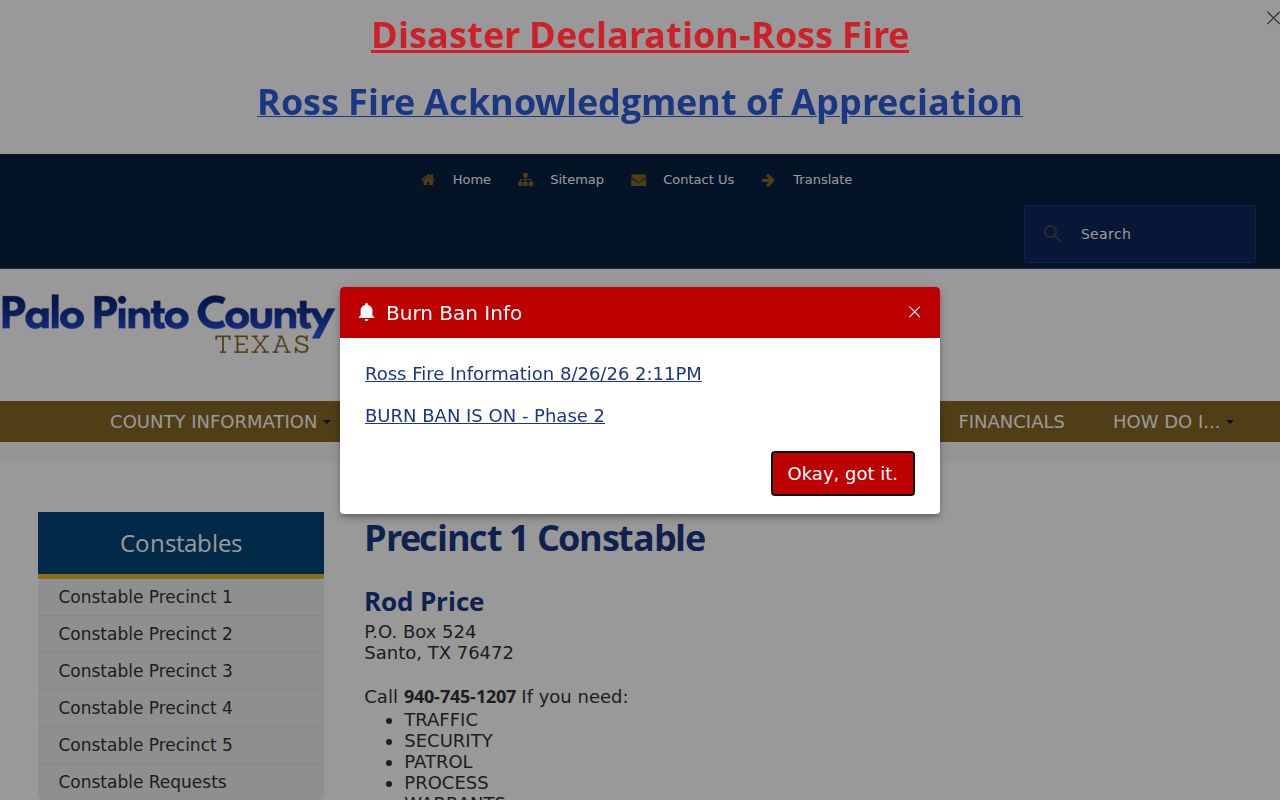
The officer directory identifies process offices, while only the court that issued an order can confirm its current status.
Which Palo Pinto County Court Issued It
A bench warrant is connected to the court that set the missed date or entered the underlying judgment. The sheriff may execute an order, but the clerk for the issuing court can identify the case and explain what filing or appearance is required. Start from the document in hand, not an assumption that every warrant belongs to the County Sheriff.
Check whether the case is in a city's municipal court, a JP precinct, or the district court. The County Clerk's criminal records are not a countywide name-search service and require a cause number; district court matters use a separate clerk. Use the Palo Pinto County warrant-search steps to route a request and verify the originating court.
Palo Pinto County District Bench Warrants Need a District Clerk Record
A district-court bench warrant remains attached to its district case. The District Clerk is separate from the County Clerk and the JP precincts; the research located a records contact but no district warrant portal or special warrant request form. Give the clerk the cause number and ask what case information is available and which court filing controls.
Use the Palo Pinto County District Court page to identify the district court route. A clerk can direct the reader to the correct record custodian, while only the court can recall its order.